Peter Livingston Scholars Program
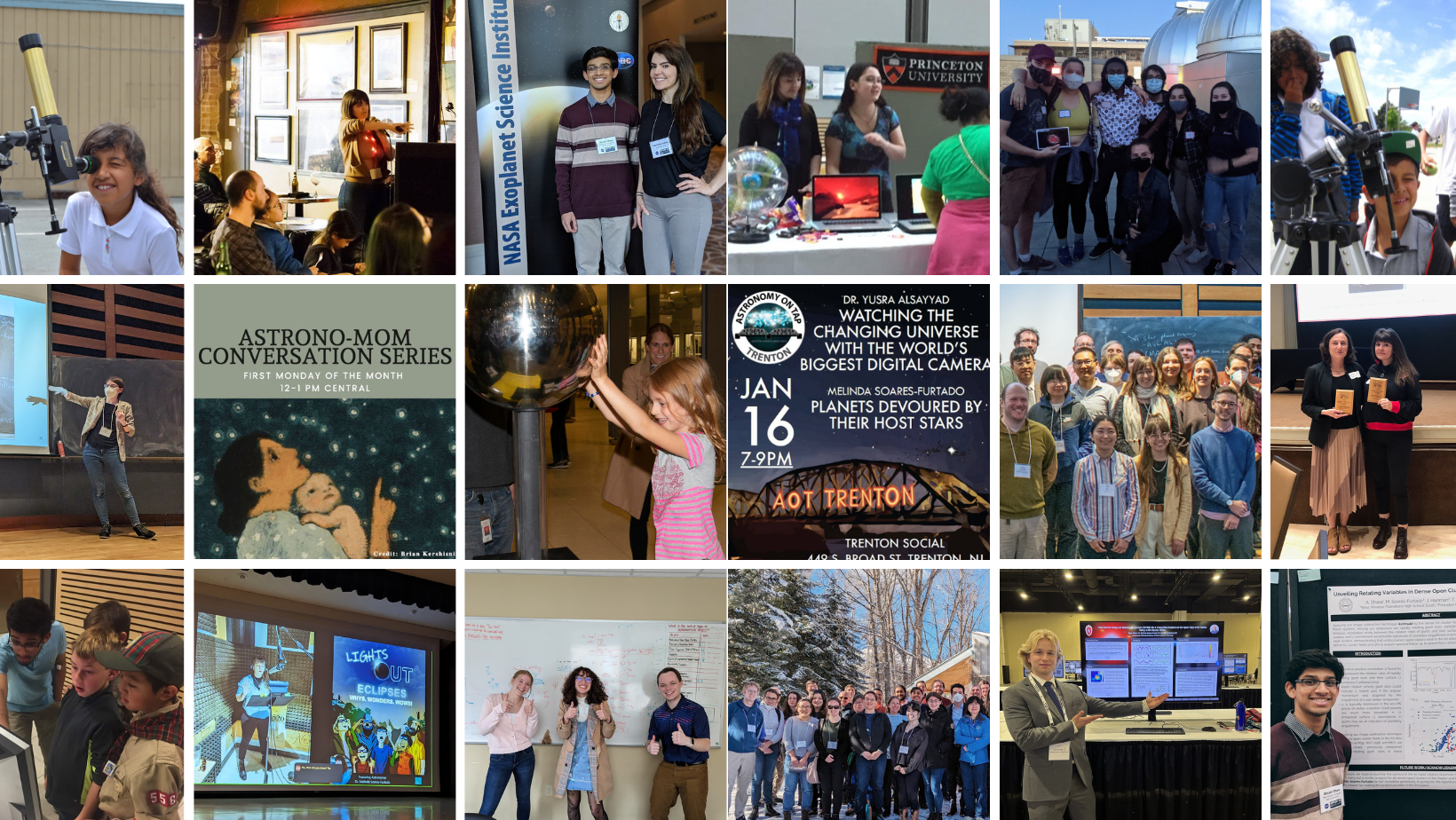
Leading the Peter Livingston Scholars Program is a major focus of my mentoring and outreach work. The program reduces financial barriers to research, supporting UW–Madison undergraduate students as they work with mentors in the Department of Astronomy. I shape its vision, oversee its operations, and work to sustain its long-term support.
As of October 2026, the program has supported 21 scholars, whose research has contributed to seven papers published in peer-reviewed journals.
This work is made possible by the generosity of Sharon Stark, in loving memory of her late husband, Peter Livingston. Peter was a longtime member and former chair of the UW–Madison Department of Astronomy’s Board of Visitors. Read about Sharon’s commitment to UW–Madison.
Mentoring Early Career Scientists
Mentoring is pivotal to student success and well-being. Throughout my academic journey, I have had the privilege to work with a number of talented high school, undergraduate, and graduate students. I have found that mentoring strengthens my science communication, leads to greater innovation and scientific insight, and continually renews my passion for academic work. In 2023, I was awarded the Postdoc Excellence Award in Mentoring by the University of Wisconsin-Madison Postdoctoral Association.
RADIAL Program
The RADIAL program brings together a dedicated team of mentors and talented summer students to collaborate on advanced research projects in astronomy. As Site Director, I help to define the strategic vision, secure funding to sustain and expand local initiatives, and recruit mentors who bring expertise and innovation to the program. I focus on connecting these mentors with promising students, ensuring they gain meaningful research experience while developing the technical and professional skills required to meet real-world challenges and contribute to the advancement of STEM.
University Partnerships
I've been privileged to work closely with a community of skilled academics who are deeply committed to meaningful science outreach. These exceptional leaders have not only inspired me, but they have also taught me the skills required to cultivate inclusive communities. More specifically, I have worked closely with the Lamat Institute for almost a decade. Today, I serve as an Advisory Board member, summer instructor, and student mentor for the program. As a student at UCSC, I worked with the Academic Excellence Program (ACE). As an ACE Peer Mentor, I played a crucial role in facilitating small group discussions and activities, aiming to deepen the students' understanding of physics concepts.
Community Partnerships
Partnering with the Milwaukee Public Museum (MPM) has provided a meaningful opportunity to share my scientific work with the broader public. In alignment with the principles of the Wisconsin Idea, this mutually beneficial partnership leverages university resources and expertise to create educational programs that are accessible to all members of the community. I recently had the opportunity to film a planetarium show that was written and directed by Bob Bonadurer, the MPM Planetarium Director. Titled "Lights Out! Eclipses: Whys, Wonders, and Wows", the show delves deep into the fascinating science of eclipses, unraveling the mysteries behind these spectacular celestial events.
I have also teamed up with MPM to host other signature events, including their recurring Science on Tap speaker series. These free public lectures are designed to make science accessible and engaging. Additionally, participating in the Learn With An Expert series provided me with an opportunity to interact with hundreds of 1st to 4th grade students throughout Wisconsin, sharing insights about my journey and career as an astronomer. Through these initiatives, MPM is fostering a community of curiosity, encouraging lifelong learning and a deep appreciation for the wonders of science.
Before coming to Madison, I worked with a talented group of astronomers to cocreate the Astronomy on Tap chapter in Trenton, New Jersey. I am currently an active participant in the Astronomy on Tap chapter in Madison, Wisconsin. I have also had the opportunity to team up with the Astronomy on Tap chapters in Pennsylvania and Las Vegas.
Conference Organization
I co-organized the Planets in the Galactic Context Workshop at the Center for Computational Astrophysics (CCA) in 2026. The meeting brought together expertise in exoplanets, stellar astrophysics, and Galactic astronomy at a pivotal moment for these fields. Surveys increasingly measure the same stars, linking planet discoveries with stellar ages, chemical abundances, and motions through the Milky Way. Combining these overlapping datasets and complementary expertise allows us to place planetary systems in their Galactic context at an unprecedented scale—and investigate how the Galaxy’s history shapes the planets that form within it.
I have co-organized several major physics and astronomy conferences, including the APS Conferences for Undergraduate Women in Physics (CUWiP) and the Young Women's Conference in STEM.
In March 2023, I co-organized Exoplanet Systems and Stellar Life Cycles: Late-Stage and Post-MS Systems at the Aspen Center for Physics. The meeting brought together experts in stellar evolution, planetary dynamics, and exoplanet demographics to investigate what happens to planetary systems as their host stars age. A central goal was to connect observations of surviving planets and the chemical traces of engulfed worlds with models of planetary evolution. These connections help us reconstruct the histories and compositions of planetary systems, including those around evolved stars and white dwarfs. I secured travel support to help early-career scientists participate.
In Fall 2025, I helped to co-organize the Great Lakes Exoplanet Area Meeting at UW-Madison, again securing travel support to ensure broad participation among early-career scholars.